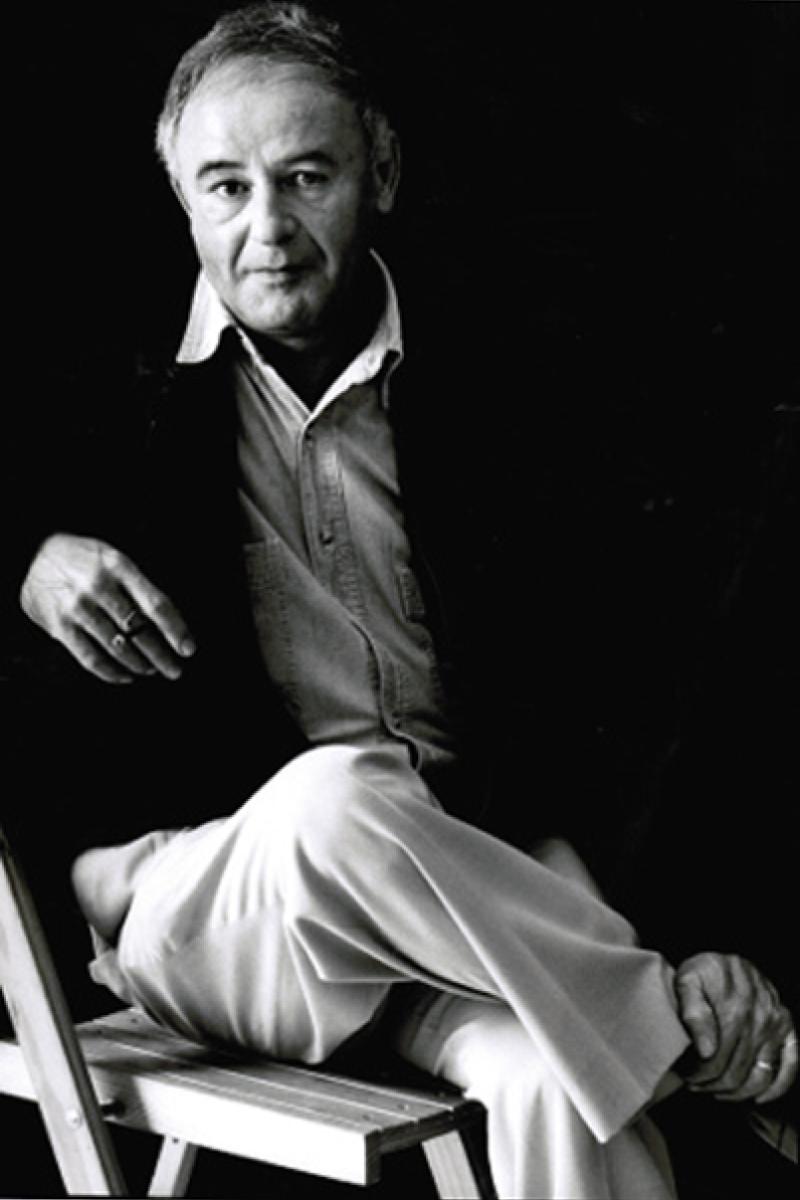
Antonio Jiménez (Málaga, 1945–2011) is one of the most unique voices in Spanish painting from the second half of the 20th century. A precocious autodidact, he began exhibiting in the late 1950s and, after spending time in Madrid and Paris, established a career marked by authenticity and expressive power. His work soon gained international recognition with his participation in ART 3'72 Basel and Documenta Kassel, and was the subject of awards and exhibitions in Spain, France, Germany, Portugal, Italy, Canada and the United States.

An inexhaustible creator, he developed a pictorial and sculptural universe that oscillates between the dreamlike and the visceral, between matter and light. His deeply personal language combines a surrealist heritage, material expressionism and Mediterranean lyricism. Sand, earth, mineral powders and pigments are amalgamated into surfaces of intense symbolic charge, where material density coexists with vibrant colours that refer to his native land. His works reveal the struggle between horror and goodness, the celebration of life and mystery, becoming authentic landscapes of the soul.

A workshop man and tireless worker, Antonio Jiménez forged a body of work that transcends fashions and borders. From Málaga, he projected a visual poetics that dialogues with the universal, without ever renouncing his inner world. His painting — ‘half blood and half dream,’ as he himself defined it — reflects not only the complexity of his imagination, but also the honesty of an artist true to himself, who ceaselessly explored the limits of form, colour and matter.

Antonio Jiménez's artistic career

Beginnings and training (1945–1960s)

Born in Malaga in 1945. From adolescence onwards, he taught himself to paint, holding his first solo exhibition in 1959. Between the late 1950s and early 1960s, he moved to Madrid, where he became involved with the Ateneo cultural centre, and travelled to Paris, where he came into contact with European modernism. His early works evolved from Impressionism towards a personal form of Expressionism with Mediterranean roots.

Consolidation and international projection (1970s)

He won several national painting awards (Salamanca, Zamora, Málaga) and participated in international milestones such as ART 3'72 Basel and Documenta in Kassel. In 1977, he held a solo exhibition at the Spanish Museum of Contemporary Art (Madrid). His painting combines surrealism, baroque style and matter, and he began to experiment with sculptures and large formats.

Grupo Palmo and creative expansion (1980s)

In 1979, he co-founded Grupo Palmo in Malaga, revitalising the local art scene. Throughout the decade, he intensively developed his drawing, graphic work and sculpture, incorporating earth, sand and mineral powders into his paintings. He exhibited in Granada, Córdoba, Seville and Marbella, and received awards such as the Francisco Gil National Painting Prize (1978) and the VIII Marbella Biennial Prize (1985).

International projection and monumental series (1990s)

His exhibitions have multiplied in Paris, Lisbon, Quebec, Miami, New York, Düsseldorf, Helsinki, Luxembourg, Rotterdam, Bologna and Andorra, in addition to his participation in ARCO and Art Miami. He explores large formats with a strong material and symbolic charge, culminating in the series on the great rivers of the world (1998–1999), dedicated to the Amazon, Nile, Yangtze, Ganges, among others.

Recognition and synthesis (2000s)

At the beginning of the decade, the anthological exhibitions El Sur del Sol (1968–2000) were held at the Episcopal Palace in Malaga (2001) and at the Convent of Santa Inés in Seville (2002), covering more than thirty years of creation. He also exhibited in Lisbon, Valencia and Benalmádena, and continued his intense workshop work. In 2012, he received a posthumous tribute at the Galerie Yvon Desgagnés in Quebec.

Work in collections

His work forms part of institutions such as the Reina Sofía Museum (Madrid), Malaga Museum, Castellón Museum of Contemporary Art, Jerusalem Museum, Villafamés Museum, Banco Santander Foundation, Deutsche Bank, Unicaja, among many other public and private collections in Europe and America.